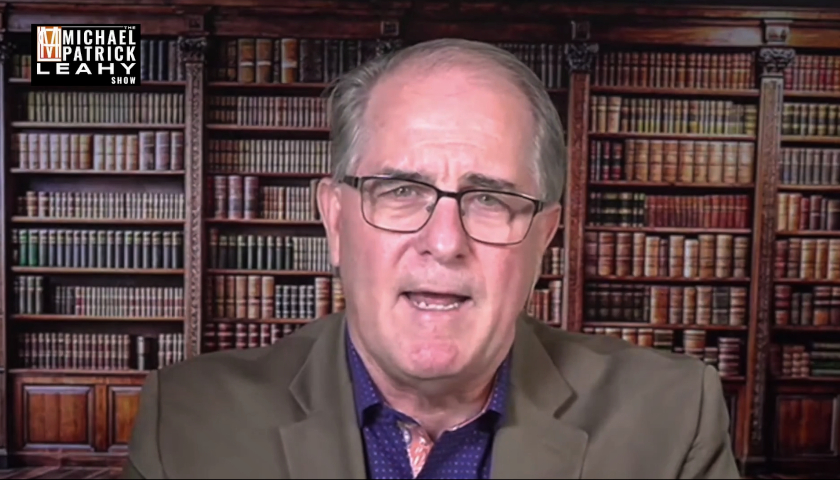
Legal commentator and retired attorney Mark Pulliam said the controversy surrounding the selection of retired U.S. District Judge Gregory Van Tatenhove as dean of the University of Kentucky College of Law highlights what he argues is a decades-long ideological transformation of legal education driven by the American Bar Association (ABA) and the nation’s law schools.
Speaking on Monday’s edition of The Michael Patrick Leahy Show, Pulliam said many Americans question why the legal system appears increasingly hostile to conservative causes, arguing that the shift was intentional rather than accidental.
“People wonder, Americans, ordinary Americans, why the legal system seems to be so rigged in favor of the left, and why they do all these crazy things to frustrate and undermine the MAGA agenda,” he said. “This didn’t happen overnight, and it didn’t happen by accident. This is all a very calculated long-term strategy of the left as they march through all of our institutions one after another and capture them, take them over, and use them as weapons.”
Pulliam traced the transformation to changes within legal education beginning in the 1960s.
“What has happened with the legal academy, the law schools, is starting in the ’60s and then it just progressively got worse,” Pulliam said. “Instead of law schools having reputable scholars, accomplished practitioners teaching the law, it all became a very theoretical exercise.”
He argued that law schools increasingly favored hiring graduates from elite institutions over experienced attorneys.
“You hire people that got good grades at Harvard or Yale Law School, and maybe they’re misfits, maybe they didn’t fit into the law firm business, so they ended up going to the ivory tower,” Pulliam said. “Then once they got there, they decided, ‘Hey, if we work together, we could take over the legal academy, and we could get some of our ancillary organizations to help us out.'”
According to Pulliam, one of those organizations is the ABA, which he said exercises significant influence over legal education through its accreditation authority.
“The state supreme courts have given the ABA monopoly power over the accreditation of law schools,” he said. “Nobody’s gonna go to law school, particularly as expensive as it is these days, if when they graduate they’re not eligible to take the bar exam.”
Pulliam said ABA accreditation standards have expanded far beyond traditional educational requirements.
“It used to be that those requirements were you had to have a library that had a certain number of books, you had to have a certain faculty-student ratio, et cetera,” he said. “Now the ABA has gotten very deep into how faculty are selected, the admission criteria for students, what’s taught, how it’s taught.”
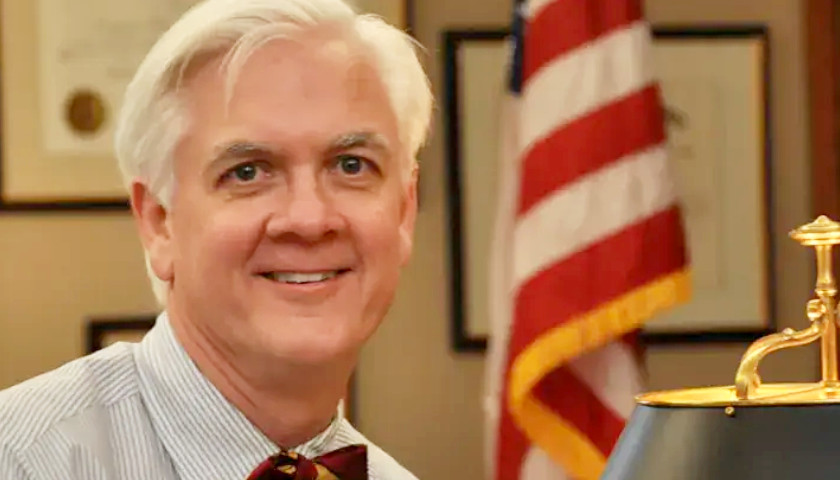
Pulliam said those dynamics became visible after the University of Kentucky selected Van Tatenhove, who served approximately 20 years as a federal judge after being appointed by President George W. Bush in 2006, to lead its law school.
Describing Van Tatenhove’s legal background, Pulliam noted that the judge also served as U.S. attorney for the Eastern District of Kentucky, clerked for a federal judge, and worked as chief of staff for a Kentucky congressman before joining the bench.
“He had a broad, wide-ranging legal background,” he said.
Pulliam explained Van Tatenhove emerged as the successful candidate after a search committee interviewed applicants and the university’s provost selected him for the position.
“You would think the people up at the University of Kentucky, and particularly the College of Law, would be pretty happy to get a guy who has 20 years on the bench, has all this experience, big name, would bring a lot of status and prestige to the law school,” he said. “They would be celebrating, having a party for the guy.”
Instead, Pulliam said, portions of the law school faculty opposed the appointment.
“They’re in an uproar because he’s not one of them,” he said. “Who actually has practiced law.”
Pulliam contrasted Van Tatenhove’s legal experience with what he characterized as the priorities of many legal academics.
“The rest of these guys, they sit around writing articles that nobody reads. They’re not even peer-reviewed,” he said. “All these law review articles are basically edited and selected by students who really don’t know anything by the time they’re doing this. It’s, of all the academic disciplines, it’s the one that’s the least rigorous.”
According to Pulliam, faculty members publicly stated that Van Tatenhove was the only unacceptable candidate among the finalists for the position.
“They said, of the four candidates that were being considered, he was the only one that was unacceptable,” Pulliam said.
Pulliam also criticized Kentucky Governor Andy Beshear for weighing in on the controversy, saying the dispute later escalated beyond internal university politics after suspended University of Kentucky law professor Ramsi Woodcock filed a federal lawsuit challenging Van Tatenhove’s appointment.
Pulliam said Woodcock, an antitrust professor who was suspended after circulating a petition supporting Hamas and calling for Israel’s destruction, filed the lawsuit in the U.S. District Court for the Eastern District of Kentucky.
Because Van Tatenhove previously served on that court, Pulliam said every judge in the district recused from the case.
“Everybody on the Eastern District of Kentucky bench had to recuse themselves,” he said. “So this lawsuit is floating around, and it’s now on the desk of the chief judge of the Sixth Circuit… who’s gonna have to find somebody, possibly even out of state, to hear this case.”
Pulliam said one of Woodcock’s legal theories is that the selection of Van Tatenhove as dean violates his constitutional rights.
“One of his theories is that, ‘As a scholar, I’m entitled to be peer reviewed by the dean of the law school, and if the dean is not somebody I like, that violates my First Amendment right of expressive association,'” he said.
Pulliam dismissed the argument outright.
“That’s ridiculous,” he said.
Watch The Michael Patrick Leahy Show – your AMERICA FIRST news talk!
– Watch now here on X
– Watch LIVE on YouTube / Rumble / Roku / AppleTV
– Listen on Spotify
– Listen on WENO AM760 in Nashville
– Read more at @TheTNStar pic.twitter.com/ZyFihktWRV— Michael Patrick Leahy (@michaelpleahy) July 20, 2026
– – –
Kaitlin Housler is a reporter at The Tennessee Star and The Star News Network.
Photo “Gregory Van Tatenhove ” by University of Kentucky.